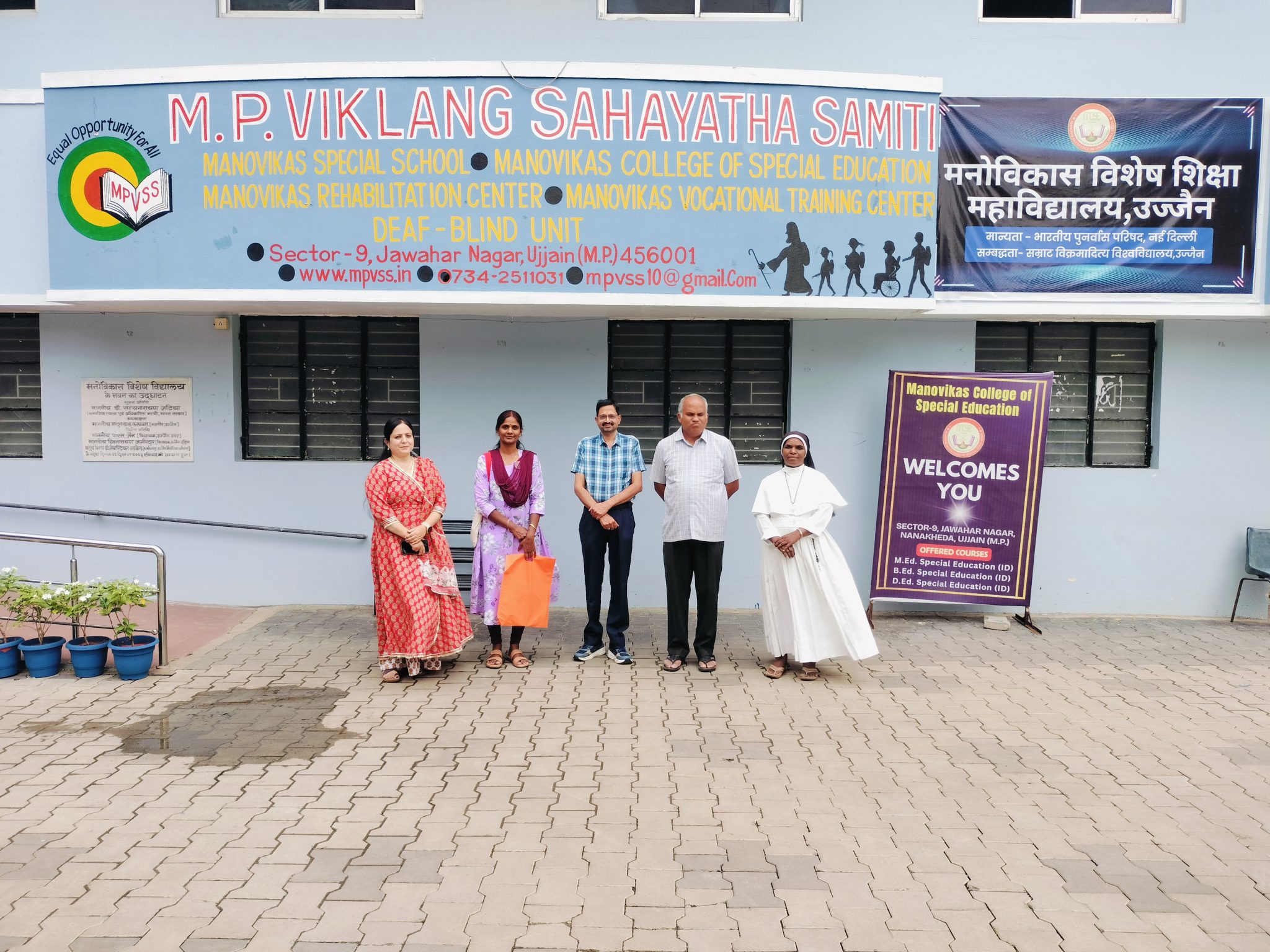
Visit to M. P. Viklang Sahayatha Samiti For Rehabilitation Training

Visit to M. P. Viklang Sahayatha Samiti For Rehabilitation Training

Introduction

Madhya Pradesh Viklang Sahayta Samiti (MPVSS) is a non-profit organization working towards improving the lives of persons with disabilities in Madhya Pradesh. The organization has a long-standing commitment to disability rehabilitation and implements a range of programmes, including institutional services such as special education and community-based rehabilitation.

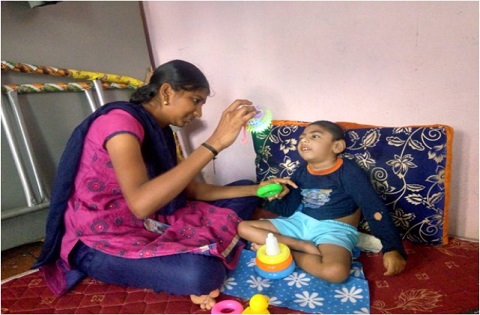
MPVSS also implements a Community-Based Early Intervention and Rehabilitation Programme, supported by the Azim Premji Foundation. Initiated three years ago, the programme currently reaches approximately 120 children with disabilities within a 15-kilometre radius of Ujjain town, providing early identification, intervention and rehabilitation services closer to children and their families.

As part of its efforts to strengthen the quality of its early intervention and rehabilitation services, MPVSS requested Amar Seva Sangam (ASSA) to conduct a capacity-building training for its staff. The training focused on strengthening staff knowledge and skills in monitoring and evaluation (M&E) and introducing them to various assessment tools used in early intervention and childhood rehabilitation. The training aimed to enhance systematic assessment, documentation, monitoring of children’s progress, and evidence-based planning of rehabilitation interventions.

Training Content and Methodology

Duration:

Based on the identified capacity-building needs of MPVSS, a 11-day structured training programme was planned, comprising five half days of online training followed by six days of in-person training.

Participants:

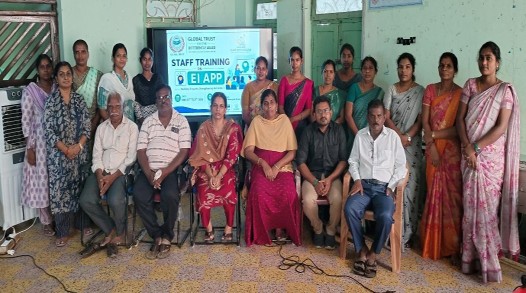
The training was attended by 15 staff members, including five Community-Based Rehabilitation (CBR) workers, six special educators, two physiotherapists, one social worker and one coordinator. The training was conducted as planned, with the online component providing the foundational knowledge required for the more practical and application-oriented in-person sessions.

Online Training flow:

The five-day online training began with an introduction to anatomy and physiology, covering various body systems, along with development and disability screening. This was followed by an overview of motor impairment conditions, intellectual impairment conditions, and sensory impairment conditions, including sensory processing disorder. The final session introduced the relationship between impairment, activities and participation and the importance of looking at the child from a holistic perspective. Participants were also introduced to the concept of developing a general holistic child profile as a foundation for further assessment and intervention planning.

In person training flow:

The six-day in-person training built upon this foundation through detailed, practical exploration of assessment and rehabilitation processes. The initial sessions focused on holistic assessment, with participants being introduced to discipline-specific assessment approaches, including physiotherapy assessment and GMFCS, occupational therapy assessment, sensory processing disorder checklist, fine motor and trunk control assessment, special education assessment, behavioural assessment and FVA, speech and communication assessment, and environmental assessment.
The training then progressed to monitoring and evaluation, with participants introduced to the principles of M&E and a range of functional assessment tools, including GMFM, PEDI, FIM and fine motor evaluation. Other assessment and educational tools covered included Basic MR, FACP, Portage, and Inclusion I and II. This helped participants understand not only how to assess children, but also how assessment findings can be used to monitor progress and support decision-making.

The subsequent sessions focused on translating assessment findings into meaningful goals and intervention plans. Participants were introduced to SMART goal setting, followed by holistic intervention planning and an overview of physiotherapy, occupational therapy, special education, and speech and communication interventions. The role of assistive devices was also discussed as part of a comprehensive rehabilitation approach.

The final phase of the training emphasized application of learning through case studies. Participants worked through the process of assessment, goal setting and holistic intervention planning using case-based examples. They presented their case work, enabling the trainers to review their understanding, clarify doubts and provide feedback. The programme concluded with case presentations and closing remarks.

Overall, the training followed a theory-to-practice approach, gradually moving from basic concepts of child development and disability to comprehensive assessment, monitoring and evaluation, goal setting, intervention planning and case-based application. This structured flow was intended to strengthen the staff’s capacity to use assessment findings systematically and translate them into individualized, functional and holistic rehabilitation plans for children with disabilities.
Pre and Post tests:

To measure the impact of the training, a pretest and post test was conducted. The total participants are 15 and their average pre test score before training is 5.4 out of 10 and their average post test score is 8.4 out of 10.

Scroll to Top
Skip to content